
Seveso sites and fire safety: what do major-accident rules require of your installation?
Vragen? Neem contact met ons op!
If you handle large quantities of hazardous substances, your site falls under the EU Seveso III Directive, which every member state implements in its own law. In the Netherlands that law was the BRZO (Besluit risico's zware ongevallen 2015) until the end of 2023. Since 1 January 2024 the BRZO has been absorbed into the Dutch Environment and Planning Act (Omgevingswet), and the sites are now called Seveso establishments. In 2024 there were 417 in the Netherlands: 268 upper-tier and 149 lower-tier. The core requirement is the same everywhere: you must show that you prevent major accidents and limit their consequences.
In this article you will read, using the Dutch rules as an example, what the Seveso requirements ask of your installation, where fire fits in and how passive fire protection limits the damage.
Questions about fire protection in your installation? Get in touch!
From BRZO to Seveso establishment: what changed in 2024
The BRZO was the Dutch implementation of the Seveso III Directive, named after the Italian town of Seveso, where a toxic gas cloud escaped from a chemical plant in 1976. Since 2024 the rules sit in the decrees under the Omgevingswet. The part on worker safety is in Dutch occupational health and safety law.
For the operator, little has changed in substance. Supervision continues too: the joint inspection body BRZO+ is now called SEVESO+. The Netherlands Labour Authority explains the new division of the rules (in Dutch).
What the rules require of BRZO sites
The Seveso rules set goals, not products. You decide which measures are appropriate and justify that choice in three documents. The Dutch government information point IPLO explains article by article what they must contain.
-
Major accident prevention policy (PBZO) – mandatory for every Seveso establishment.
-
Safety management system (VBS) – the organisation, procedures and resources that put that policy into practice, including maintenance.
-
Safety report – upper-tier sites only, including an estimate of the likelihood and scale of a major accident.
How a Seveso inspection looks at your installation
Dutch Seveso establishments get a yearly inspection lasting several days from a team of authorities. They check whether your safety management system is properly documented and whether it works in practice.
The condition of the equipment counts too. The Labour Authority currently pays extra attention to pressure equipment, explosive atmospheres and maintenance management, among other things. That last point directly affects fire protection: a measure that was not put back after a maintenance shutdown does nothing at that moment.
Where fire makes the difference in your major-accident scenarios
In a hydrocarbon fire, temperatures rise above 1000 °C within minutes, as a pool fire or as a jet fire from a pressurised leak. The biggest danger is escalation: the fire reaches the components you need to bring the incident under control.
Take a cable tray that controls the emergency shutdown valves of a process furnace. If it burns through, the valves may no longer close and fuel keeps flowing to the fire. If your safety report assumes such components keep working for a certain time, you have to be able to deliver on that.
This is where it often goes wrong in practice. Fixed fireproofing around valves and flanges has to come off for maintenance and does not always go back correctly. You only notice that gap during an inspection, or during a fire.
What passive fire protection does
Passive fire protection (PFP) slows down the heating of a component without anything needing to be switched on. Protection is expressed in minutes, usually 30, 60, 90 or 120. The rating you need follows from your risk analysis and your scenarios.
-
Works without intervention – protection stays in place even if power, controls or fire water supply fail.
-
Time for a safe emergency shutdown – valves and their controls stay operational for longer, so you can isolate the process feed.
-
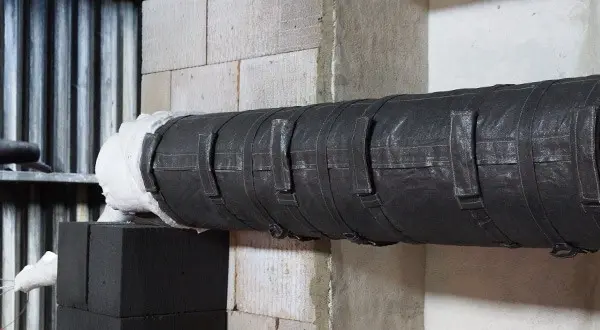
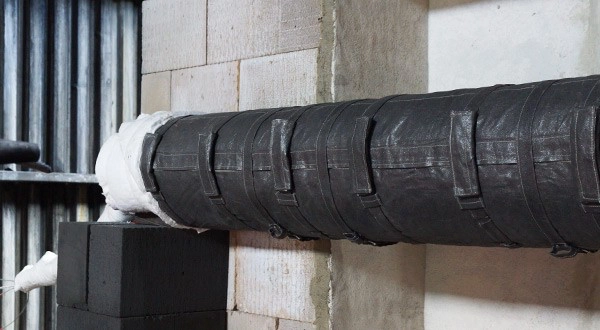
Stays in place after maintenance – you take a removable fire protection jacket off for maintenance and refit it afterwards.
What it gives you at the Seveso inspection
With tested, certified fire protection jackets you can show per component which fire scenario it is protected against and for how long. Record that in your safety management system, together with the procedure that the jacket goes back on after every intervention. An inspector then sees that the measure is documented and works.
It also protects continuity: a fire that stays at its source causes less damage and a shorter shutdown. Read more about our work in industry on our sector page.
How Econtras helps you
Econtras makes fire protection insulation jackets from JetBlack® PFP, fully custom-made. JetBlack® PFP 120 protects for 120 minutes against jet fire, pool fire and hydrocarbon fire to UL 1709, at 1150 °C. The jackets are light and reusable.
You decide with your safety specialist which components fall within your scenarios and what fire rating they need. We measure, design, manufacture and deliver in time for your maintenance shutdown. At Shell Moerdijk we did this during a plant turnaround for about 200 metres of cable tray controlling the emergency shutdown valves of the process furnaces.
Conclusion
Whatever the national name of the rules, you have to show that a fire will not escalate into a major accident. So protect the components your scenarios rely on, and make sure that protection is back in place after every maintenance shutdown.
Want to know which components in your installation need extra protection? Get in touch and we will gladly go through your critical points with you.
Want your critical components reviewed? Get in touch!