
Recognised Measures List (EML): how insulation blankets meet the energy-saving obligation
Vragen? Neem contact met ons op!

Since July 2023, a tightened energy-saving obligation has been in force. Companies with an annual consumption above 50,000 kWh of electricity or 25,000 m³ of natural gas fall under this obligation. They must take all measures that pay for themselves within five years. Insulation blankets are on the Recognised Measures List (EML) of the RVO and therefore count directly towards this.
In this blog you'll read why insulation blankets are on the EML and where in your installation you achieve the fastest result.
What the energy-saving obligation and the reporting obligation require of you
The energy-saving obligation applies to companies and institutions above these consumption thresholds. On top of that comes the reporting obligation: once every four years you report to the RVO which measures you have implemented. Companies that fail to do so risk enforcement by their environmental service.
The full explanation of when the obligation applies to you and how to report, you can read in our blog about the energy-saving obligation.
Why insulation blankets are on the Recognised Measures List
To meet the energy-saving obligation, a measure must pay for itself within five years. In practice, insulation blankets often pay for themselves within six months to two years. That's why the RVO included them in the Recognised Measures List (EML).
By applying an EML measure, you demonstrate a recognised and proven measure as part of your reporting obligation. You can view the full list on the RVO website.
Where heat loss most often occurs
Pipes are given standard technical insulation in most installations. Insulation shells or blankets are easy to fit on a straight pipe. Fittings and valves are often left unprotected in practice, while that is exactly where a lot of heat is lost.
A valve or flange has an irregular shape and is regularly opened for inspection or maintenance. With fixed insulation, the material is then often removed and not put back after the maintenance stop. Sometimes it disappears altogether. That results in components that continuously leak heat, leading to higher energy costs and unnecessary CO2 emissions.
What makes an insulation blanket different from fixed insulation
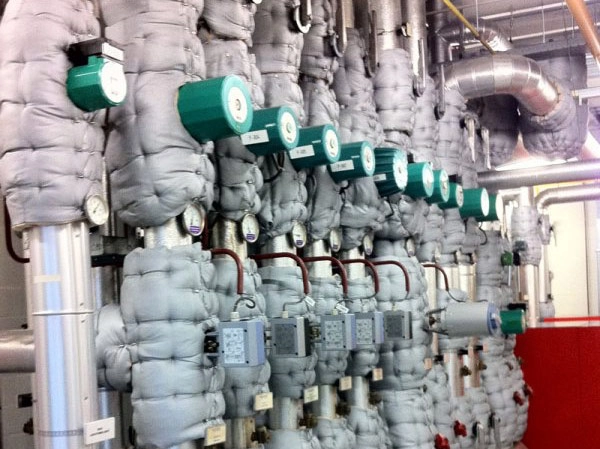
An insulation blanket is a flexible, removable cover that is custom-made for a specific component. For maintenance you simply take it off, and afterwards it fits snugly around the component again.
The effect is significant: up to 85% less heat loss at fittings and valves. Because the blanket can be reused, the insulation also remains intact after maintenance.
What this delivers for your energy-saving obligation
With insulation blankets you comply directly with the statutory obligation. They fall exactly into the category of measures that pay for themselves within five years. Because they are on the Recognised Measures List, you can demonstrate this as part of your reporting obligation.
Heat that would otherwise be lost through fittings and valves is now retained. You'll see this reflected in a lower energy bill, lower CO2 emissions and a safer working environment.
How Econtras helps you with this
At Econtras we make insulation blankets fully custom-made, from a single fitting to a complete steam boiler or turbine. We come and measure it ourselves, so the blanket fits precisely and the insulation value is right from day one.
Our thermal insulation blankets are developed for installations with high heat loss, from steam pipes to boiler rooms. You can view the full range and technical specifications on the product page.
Conclusion
Insulation blankets are a recognised measure with a payback period well within the statutory five-year requirement. They lower your energy consumption, support your reporting obligation to the RVO and improve safety around your installation.
Want to know how much your company can save and how quickly you can meet the EML requirement? Feel free to contact us, we're happy to work it out for you.